
AI News · Week 232 June 2026
Claude Opus 4.8 is here.And what else matters this week.
Anthropic releases Claude Opus 4.8 and doubles the limits of Claude Design, while Perplexity moves into the Office apps. Plus a look ahead to Microsoft Build and Google’s Gemini for Business, and Codex for Windows.
01 · Anthropic
Claude Opus 4.8: more performance, same price, and you control the effort.
On Thursday, Anthropic released Claude Opus 4.8, its new top model. It is available worldwide with immediate effect, at the same price as its predecessor. According to Anthropic, it has sharper judgement, is more honest about its own progress and has more stamina on long tasks.
The practically relevant part is the new effort control right next to the model selector. It is included in all plans, even the cheapest. You decide per task how deeply Claude thinks: a high level for tricky analyses, a low one for quick routine answers that go easy on your limit. In addition, Fast Mode now runs 2.5 times faster and costs only a third of its previous price.
What does this mean for you?
For everyday work, the effort control matters more than the benchmark figures. Turn it down for routine texts, which saves limit, and up for analyses and longer builds. You do not need to change anything when switching, the same price applies immediately.
Source: Anthropic: Claude Opus 4.8
02 · Perplexity
Perplexity moves into Word, Excel and Outlook, and stays in the race.
Perplexity’s agent “Computer” is now available as an add-in directly in Word, Excel, PowerPoint and Outlook. There is no more switching between browser and document. It has been running in Teams and SharePoint since the beginning of May. It draws context from more than 400 connected sources and, according to Perplexity, backs every statement with a source. It is available on the paid plans Pro, Max and Enterprise.
To put this in context: OpenAI with ChatGPT in PowerPoint and Anthropic with Claude in Word and PowerPoint have made exactly this move into the Microsoft apps in recent weeks. Perplexity is now following suit. The pattern is the same everywhere: AI comes to where the work happens anyway, instead of pulling you into a separate chat window.
What does this mean for you?
If you already use Perplexity and Microsoft 365, this can be a real lever: research and drafts are created directly in the document. Strategically, the move also shows that Perplexity remains relevant alongside the top dogs OpenAI, Anthropic and Google.
Source: Perplexity
03 · Anthropic
Claude Design: double the token limits on all plans.
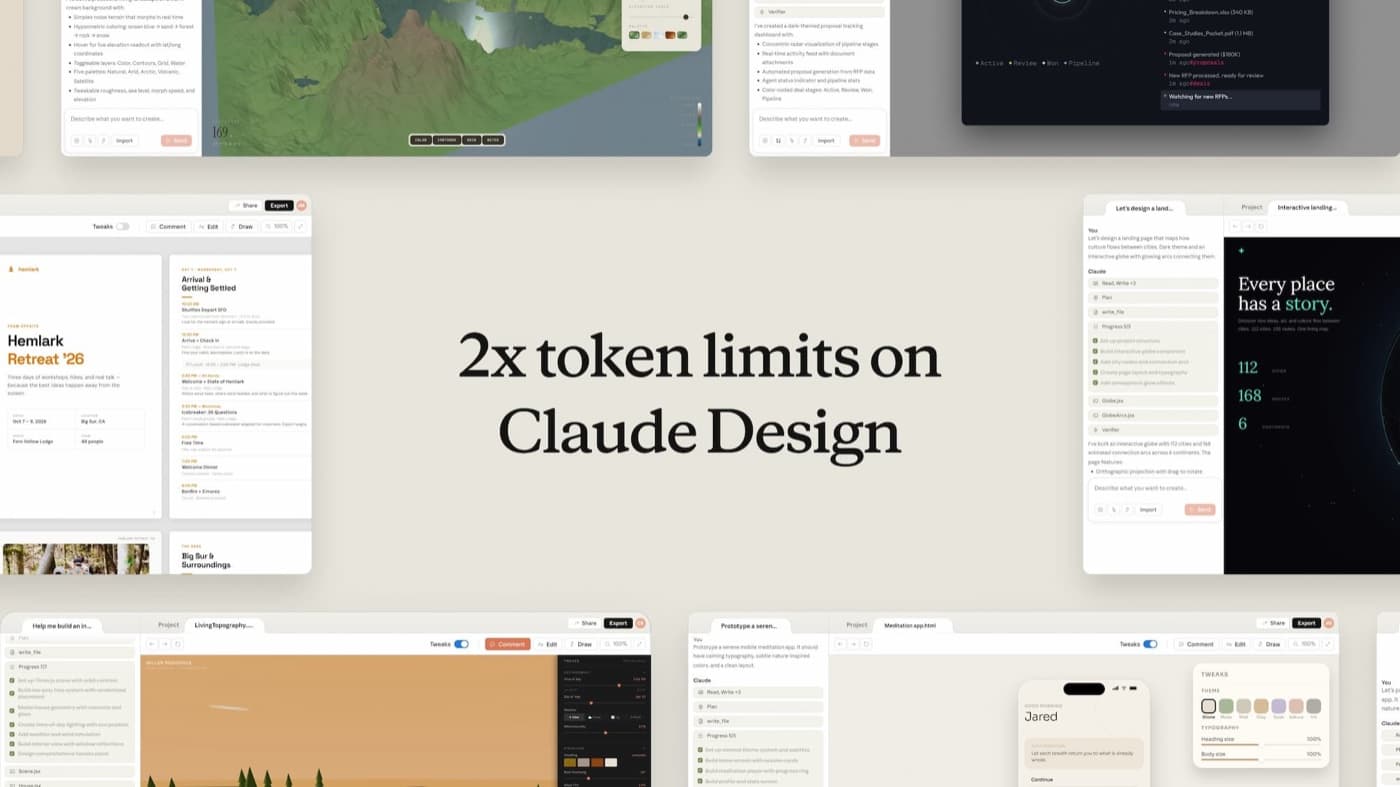
Anthropic has doubled the token limits of Claude Design, on all plans from the cheapest upwards. Claude Design generates mock-ups, slides, landing pages and marketing visuals from a text prompt. A doubled limit simply means twice as much output before the cap kicks in.
What does this mean for you?
If you regularly have slides or landing page drafts built, you now get further without starting over. Same plan, more throughput.
Source: X: @claudeai, 18.05.2026
04 · Heute & demnächst
What Microsoft Build is expected to bring, and what is maturing at Google.
Microsoft Build starts on the evening of 2 June, from 19:00 German time. According to advance reports, three new in-house models are expected: MAI Voice 2 for multilingual speech output in around 15 languages, MAI Transcribe 1.5 for transcription and MAI Image 2.5 for images, now also with image upload for editing. Nothing has been officially confirmed yet. What actually arrived will follow in the next issue.
In parallel, Google is reportedly expanding “Gemini for Business”: shared project workspaces, shared chats and workflow agents. These have so far been Enterprise features and are set to move down into the cheaper Business tier. The rollout is still staggered, and there is no official date.
What does this mean for you?
Neither is ready to try yet. Keep the direction in mind: Microsoft is pushing its own models into Copilot and Office, Google is moving team features into the cheaper tier. It only becomes reliable once it is official.
Source: TestingCatalog: Vorab-Berichte
05 · OpenAI
Codex comes to Windows, and you control the PC from your phone.
On Friday, OpenAI extended Codex, its coding agent, for Windows. The agent can now operate Windows programs directly, meaning it can see, click and type while it tests and debugs. A task started on the Windows machine can also be steered on the go via the ChatGPT app or with Codex on the Mac. The PC remains the workhorse, the phone becomes the remote control.
However, direct control of Windows programs is not available in the EEA at launch, so not in Germany, Austria, the UK or Switzerland.
What does this mean for you?
For the German-speaking region, this is therefore not yet something to use, more something to be aware of: agents are increasingly taking over real click work on the computer, with the human merely approving from the phone. It remains to be seen when this becomes usable here.
To close.The key point of the week.
The common thread of the week: AI is leaving the separate chat window and moving directly into the tools you work in every day: models, Office apps, desktop.