
AI News · Week 416 October 2026
AI moves deeper into retail and ops.From the basket to support.
The most important story this week is not a single model but the path into real operations: Albertsons brings Safeway into ChatGPT, OpenAI turns ChatGPT into a workspace and Barclays shows support automation with solid numbers. On top of that come two warning signs for everyone running agents in production: permissions on the desktop and AI slop in review processes.
01 · OpenAI, Albertsons
Albertsons brings Safeway into ChatGPT, all the way to checkout.
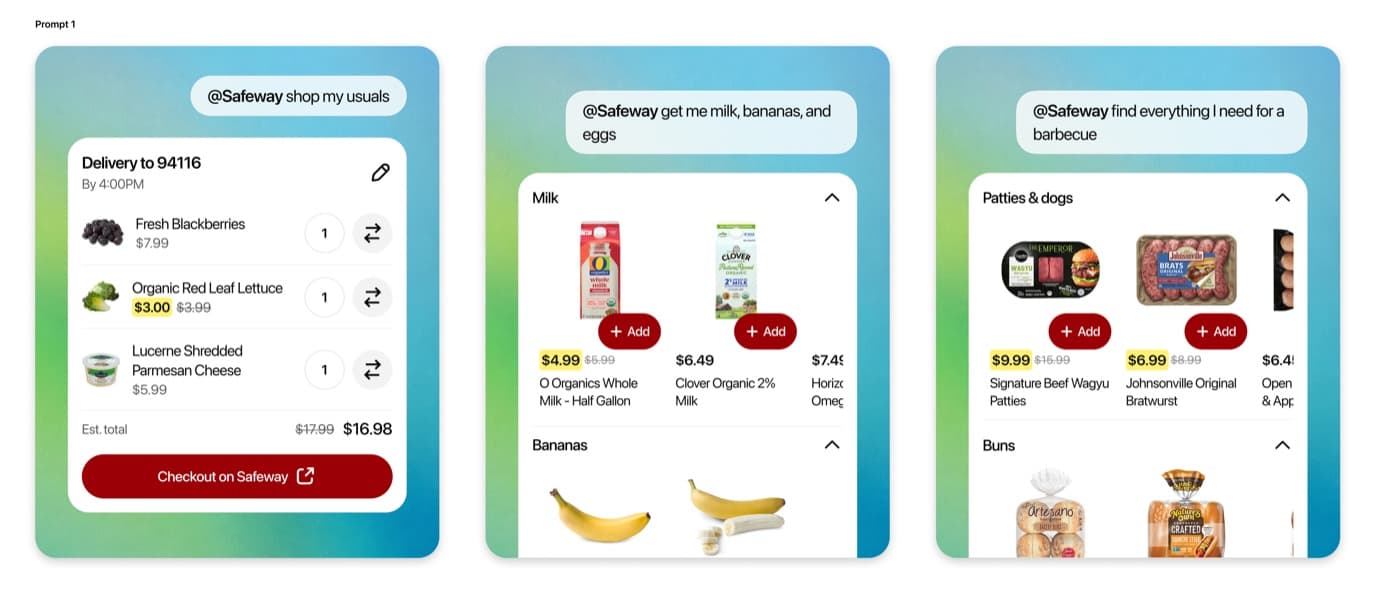
OpenAI and Albertsons are showing how close AI shopping is getting to the real basket. Albertsons operates more than 2,200 stores and, according to OpenAI, reaches over 36 million customers a week. The new Safeway Experience in ChatGPT is meant to turn a recipe, a photo, a list or a short request into matching products and savings offers and then lead to checkout at Safeway.
The second layer is what matters: Albertsons uses OpenAI not only for a chat front end but also for personalised recommendations, repeat purchases, promo insights and internal retail workflows. That is exactly where it is decided whether AI commerce brings revenue or remains just a nice demo feature.
What does this mean for you?
Check your product data as if an agent were going to read it tomorrow: variants, bundle logic, substitute products, margin rules and availability must be machine-readable, otherwise the agent will recommend the wrong items.
Source: OpenAI: Albertsons, 01.10.2026
02 · OpenAI
OpenAI turns ChatGPT into a workspace for agents and plugins.
OpenAI made more than 20 announcements at DevDay 2026. For brands, the interesting part is less the next model than the interface: Dots are meant to take over ongoing tasks, ChatGPT Spaces bundle teamwork, and Plugin Extensions give third-party products their own panels directly in ChatGPT.
This is the next stage after chatbot and copilot: AI no longer just sits next to the workflow but becomes the shared workspace for tools, files, approvals and automations. For eCommerce teams this means that processes spread today across Slack, Sheets and five SaaS tools are pulled into one agent interface.
What does this mean for you?
Collect your recurring ops workflows now, for example launch checklists, returns analysis, supplier emails or content approvals. If you cannot describe them cleanly, you cannot hand them over to agents in a meaningful way either.
Source: OpenAI: DevDay Recap, 29.09.2026
03 · Anthropic, Barclays
Barclays shows how support knowledge scales with Claude.

Anthropic reports the expansion of its partnership with Barclays. The concrete numbers are more interesting than the announcement: a Claude-based Knowledge Assistant supports more than 16,000 employees, has processed over one million searches and helps with support for more than 20 million UK retail customers.
In addition, Barclays processes around 120,000 emails a day in its Global Markets division with Claude models, for instance to classify, enrich and route enquiries. This is not a colourful chatbot but classic process design: recognise the incoming item, add context, determine the route, a human decides.
What does this mean for you?
For brands this is directly transferable: build your support and returns automation not as a free chat but as a knowledge system with clear routes, escalations and logs.
Source: Anthropic: Barclays, 01.10.2026
04 · Apple
Apple makes full access for desktop agents more explicit.
Apple is responding to the new risks posed by AI agents on the Mac and is announcing additional controls around Full Disk Access. This access can cover files, mail, messages and browser history. According to Apple, the risk grows the more autonomous agents become.
The change is not a hard block but is meant to force clearer, more deliberate consent. For companies it is a signal nonetheless: desktop agents are powerful, but their permissions belong in the same category as admin access, payment approvals and customer data exports.
What does this mean for you?
Do not give agents blanket full access just because it is faster in the demo. Set up roles, separate test and production data, and document which actions may run without human approval.
05 · Google
AI slop now hits bug bounty processes too.
Google is pausing its Open Source Software Vulnerability Rewards Program until the first quarter of 2027. According to TechCrunch, Google points to a significant rise in automated submissions, the vast majority of which it says are not valid.
This is more than a niche security topic. It shows what happens when AI pours unfiltered into review processes: teams do not get better quality but more volume, more hallucinations and more manual sorting work.
What does this mean for you?
If you use AI for QA, content review, support tickets or returns, build in a validation step. An agent may generate suggestions, but a second check has to sort out duplicates, nonsense and missing evidence.
To close.The key point of the week.
The common thread: AI becomes more valuable as soon as it is allowed into real systems. That is exactly why data quality, permissions and validation now matter more than the next prompt example.